
EON Delta is trained on the industrial incident record rather than the open internet, and is delivered in two layers so that a company’s own operating knowledge can improve its own model without ever being pooled with a competitor’s.
IRVINE, CA — August 7, 2026 — EON AI Ventures today described EON Delta, a programme to build small, specialised artificial-intelligence models for industrial safety and asset reliability, trained on the documented record of industrial incidents rather than on general internet text.
Roughly one thousand people are killed at work every day worldwide. The direct and insured cost of industrial incidents is measured in the trillions of dollars annually. Almost every one of those events had a precursor — a reading that drifted, a check that was deferred, a pattern that a sufficiently experienced engineer would have recognised. The knowledge required to catch them exists. It does not compound, because it cannot be pooled. Read more in depth about it in our EON Delta: Build Your Own AI white paper.
Click on the image below to access the EON Delta: The Complete Picture presentation.
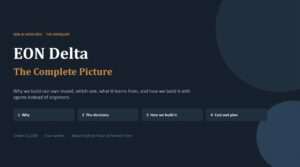
That is the problem EON Delta is built to address, and it is a structural problem rather than a technical one. Two companies operating identical equipment cannot share what each has learned about how that equipment fails. Doing so would expose competitively sensitive operating information, and in many jurisdictions it would construct an unlawful channel of communication between competitors. So the same failure is discovered independently, repeatedly, at full cost each time.
A model in two layers
EON Delta is delivered as two separable layers that combine when the system is used and can be pulled apart at any time.
| Layer | What it is trained on | Who owns it |
|---|---|---|
| Tenant Delta | Only the customer’s own material, inside the customer’s own environment. It is never trained anywhere else and never leaves. | The customer. It is Derived Insight under the EON Data Rights Standard. Returned or destroyed on exit. |
| Base Delta | Only patterns that have been independently qualified against multiple organisations, or that were already published by a regulator or standards body. | EON. It is a Generalized Learning, and it is licensed back to every participant, royalty-free, in perpetuity. |
| Why the split is the point
A dataset is a pipe: whatever goes in comes out, which is why data-sharing arrangements between competitors are so hard to write and so rarely signed. A model is a teacher. It carries the lesson without carrying the lesson’s source. The two-layer structure means a company’s own operating record improves its own model, while only patterns that have proved general — and are therefore attributable to no one — join the layer everybody shares. |
The consequence is that a participant’s departure is survivable in both directions. The tenant layer is deletable on demand and its deletion is verifiable. The shared layer is not derived from any single contributor, so it does not have to be dismantled when one leaves.
Built under constraints that are enforced by the pipeline, not promised in a contract
The governance properties above are not policy statements. They are conditions the build process refuses to proceed without.
No source enters without a licence determination
Every corpus carries a recorded determination of what it may be used for. Material from a source lacking that record is refused. The failure mode is closed: absence of a record blocks processing rather than permitting it.
No training example may contain hindsight
Incident reports are written by people who already know how the story ended. A model trained naively on them learns to be confident about situations that were genuinely ambiguous at the time — which is precisely the wrong lesson, and a lesson that improves every laboratory metric while degrading real-world judgment.
EON Delta’s training examples are constructed against a cutoff. Only information that was knowable before the event enters the question; the outcome is the answer. Where a report does not permit that reconstruction, the record is discarded rather than estimated.
No single contributor may dominate the shared layer
Before training, the proportion of examples originating with any one organisation is measured for each category and capped. A pattern can satisfy a multi-source rule while the material teaching it remains dominated by one company, in which case the model encodes that company. The cap closes that gap and records that it did.
Every model carries a verifiable record of how it was made
Each training run emits a manifest binding the examples, sources, licence determinations, composition proportions and configuration to a cryptographic hash of the resulting model. A third party can audit compliance without being given access to any training data.
Nothing that actuates equipment is ever recommended
The training material is constructed so that recommendations to operate equipment or alter a control system are absent from it. This is a stronger guarantee than filtering the model’s output, which is probabilistic and can fail. EON Delta advises a human. It does not touch the plant.
Small enough to run where the work happens
EON Delta is deliberately small. It is designed to run on hardware that can be carried into a facility rather than in a datacentre reached over a network, which matters for three reasons that have nothing to do with cost.
- Much industrial work happens where connectivity is poor, intermittent or prohibited.
- A model that runs locally cannot send anything anywhere, which resolves the data-residency question by construction rather than by assurance.
- A specialised model of modest size, trained on the right material, can outperform a far larger general model on a narrow task — and industrial safety judgment is a narrow task.
The approach is parameter-efficient fine-tuning: an open-weight base model is left unchanged and a small adapter is trained on top of it. The adapter is a fraction of one percent of the size of the base, which is what makes a per-customer model economically sensible in the first place.
Measurement first
EON is building the means to evaluate this class of system before completing the system itself, and intends to publish that evaluation openly — including its own results, whatever they are. That work is described separately.
| What is deliberately absent from this announcement
There is no performance claim anywhere in this release, because no result exists yet. EON has not measured EON Delta against anything, and will not describe it as better than any alternative until an independently reproducible measurement says so. In an announcement, a number is a commitment. This release makes none. |
Read more in the EON Delta: Build Your Own AI white paper
Learn more by tuning to our podcast.
About EON AI Ventures
EON AI Ventures is the company behind Work Intelligence — the captured, verified, and compounding knowledge of how expert work is actually done. Its Intelligence Flywheel platform (Genesis, Field IQ, Assess IQ) enables industrial enterprises to encode expert procedures into AI-guided simulations, deliver them to any worker on any device, and verify competency in the field. EON AI Ventures builds on a 25-year foundation of immersive learning technology deployed across more than 80 countries. For more information, visit www.eonaiventures.com