
Operational systems are reactive — they record the consequence after it happens. The EON Work Intelligence Flywheel makes visible the missing 55% of evidence where incidents are actually born — human judgment, authorized intent and field execution — and intervenes while the outcome can still be changed.
IRVINE, CA — July 28, 2026 — EON AI Ventures today introduced the EON Work Intelligence Flywheel, a closed learning loop built on a simple shift in where safety happens. Today’s operational systems are reactive by design: they diagnose the consequence — the pressure drop, the alarm, the shutdown — after it has already occurred. But an incident is not born in the sensor data. It is born earlier — in a decision made under uncertainty, a procedure step adapted in the field, an authority boundary crossed, a warning cue an expert would have caught. The flywheel captures that missing half and intervenes while the outcome can still be changed. The principles, architecture, and operational framework behind this proactive approach are detailed in the accompanying white paper, “Preventing Incidents Where They Are Born.”
The industry is not blind — and people still die
A modern facility already collects roughly 45% of a complete work record: pressure, flow and temperature from sensors; setpoints and alarms from SCADA and DCS; time-series memory from historians; vibration and corrosion from condition monitoring; production and downtime from outcome systems. It is a powerful nervous system. It is also, by itself, not enough.
In 2024, upstream oil and gas recorded 32 fatalities across 21 separate incidents, with explosions, fires and burns causing 41% of the deaths (IOGP, 2024). The average offshore facility loses about $38 million a year to unplanned downtime, and the worst performers exceed $88 million (Kimberlite). These are not accounting abstractions. They are people who did not go home, and value that vanished because a job did not go the way the record said it did.
| THE CORE PROBLEM
The 45% that facilities already capture is the consequence half — it tells you the pressure dropped and the alarm fired, after the fact. It cannot see the cause half: what was authorized, what the worker observed and judged, which procedure revision was truly used, and whether the safeguard was verified. You cannot prevent what you cannot see — and that missing half evaporates the moment a job closes. |
Why the missing 55% is where incidents are born
When investigators reconstruct these events, the root cause is rarely a sensor that failed to read. More than 70% of oil-and-gas accidents trace to human and organizational factors — errors in judgment, procedural lapses, gaps in job-safety analysis, and weaknesses in permit-to-work — not to the process signals the control room watches (HFACS oil-and-gas research). In other words, the decisive evidence lives almost entirely inside the half no system preserves.
That missing 55% has a structure, and EON builds each part of it:
- Human expertise — 15% (EON Tacit): the cues an expert notices, the option they reject, the moment they stop.
- Field execution — 18% (Field IQ / Edge): what physically happened at the equipment — observations, actions, exceptions, photos and readings, even offline.
- Plan + authority — 12% (Permit IQ): the authorized job, hazards, isolations, roles, limits and the evidence the work must produce.
- Simulation + governance — 10% (Genesis): the approved digital-twin state and the rules under which a lesson may be trusted and reused.
Today most of this evaporates the moment a job closes. The expert retires. The adaptation is never written down. The near-miss protects no one because the next crew never hears about it.
Click on the image below to access the Preventing Incidents Where They Are Born presentation.
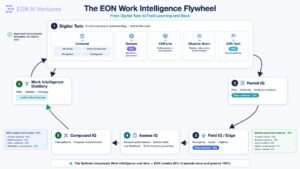
Figure 1. Six stations create and compound the Verified Work Episode. EON creates 55% of the evidence, joins the 45% that already exists, and governs the full 100%.
What EON adds — and why it compounds
The Work Intelligence Flywheel manufactures that 55%, joins it to the 45% the facility already owns, and governs the full 100% as a single Verified Work Episode — a reconstructable record of one mission, from intent to outcome. Then it does the thing a static record cannot: it turns the episode into a better next mission.
- Assess IQ measures the delta between the approved plan and what actually happened, and delivers feedback while the work is still live.
- Compound IQ finds the recurring cue, deviation or failure mode across many episodes.
- The Work Intelligence Distillery filters, validates and packages the lesson under governance, then feeds it back into the digital twin, the permit, the procedure, the training scenario, and the next mission package.
| THE COMPOUNDING EFFECT
Each turn of the wheel, the next worker arrives already knowing the cue that preceded last year’s near-miss. The permit carries a new checkpoint. The procedure closes the gap that caused the last deviation. Safety stops being a poster and becomes a property of the system that improves every cycle. |
What it prevents
Moving safety upstream — to the point where incidents are born — changes what an organization can expect from every job:
- Fewer fatalities and serious incidents — by catching the human, procedural and authority conditions that cause more than 70% of them, before they combine.
- Fewer unplanned interruptions and lower downtime cost — by proving physical work was done right the first time, cutting repeat visits, wrong-asset errors and ambiguous closeouts.
- Expertise that no longer walks out the door — the retiring expert’s judgment is captured, verified and reusable.
- Faster, more confident execution — the crew arrives with the asset context, evidence requirements and relevant experience already in hand.
- A digital twin that gets smarter every cycle — not only what the asset is, but how work on it actually succeeds.
How the 55 and 45 are derived
The split is a planning hypothesis, not audited statistics, derived in three steps. First, list the evidence categories needed to reconstruct and reuse one job’s outcome. Second, weight each by how much it proves whether the job succeeded, why, and whether the lesson can be trusted — anchored to the finding that most incidents originate in human and organizational factors, so the work-context half must outweigh the sensor half. Third, allocate to 100: the EON-created cause half sums to 55 (field execution 18, human expertise 15, plan + authority 12, simulation + governance 10) and the existing consequence half to 45. The weighting is meant to be calibrated per customer, facility, asset class and job type.
The practical path to fewer incidents and less downtime
The industry’s own data shows a data-driven approach already reduces unplanned downtime by about 36% (Kimberlite) — but that gain comes from optimizing the 45% that is already visible. The larger, still-untapped prize is the 55% where more than seven in ten incidents actually begin. Closing that loop attacks the root cause, not the symptom — and it is achievable now, because 45% of the evidence already exists and EON supplies and governs the rest.
EON recommends proving this where the ground truth is known and no one is at risk: a training center with physical skids, a simulated process and coordinated control-room and field teams can manufacture verified episodes — including rare and abnormal conditions — before the approach moves to bounded, customer-controlled field pilots.
| THE CLAIM IN ONE SENTENCE
The 45% tells you what happened. EON adds the 55% that tells you why — and compounds both into the one thing that prevents the next incident: a verified, governed lesson delivered to the next crew before they start. |
Read more in the Preventing Incidents Where They Are Born. white paper.
Learn more by tuning to our podcast.
About EON AI Ventures
EON AI Ventures is the company behind Work Intelligence — the captured, verified, and compounding knowledge of how expert work is actually done. Its Intelligence Flywheel platform (Genesis, Field IQ, Assess IQ) enables industrial enterprises to encode expert procedures into AI-guided simulations, deliver them to any worker on any device, and verify competency in the field. EON AI Ventures builds on a 25-year foundation of immersive learning technology deployed across more than 80 countries. For more information, visit www.eonaiventures.com