
A fact-grounded experiential catalog of the real medical-device use errors and failures that harm patients — every case sourced to its public safety record, and every one linked into EON’s Healthcare Living Library.
Irvine,CA — July 20,2026 — EON AI Ventures today introduced The Healthcare Situation Room, a new product in its Work Intelligence family aimed at the most under-served obligation in patient safety: teaching nurses and clinicians to recognize the device use errors that reach patients — before they make them. Read more about it in depth in the “Healthcare Situation Room” white paper.
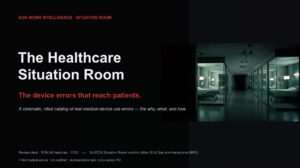
Click on the image below to access the Healthcare Situation Room presentation.
WHY
Healthcare faces a structural patient-safety problem that lives at the interface between a clinician and a machine. Infusion pumps, ventilators, monitors, and defibrillators do exactly what they are told — and that is precisely the danger, because the number on the screen confirms the value that was entered, not the dose or the setting actually reaching the bedside. The scale is documented: from 2005 to 2009 the U.S. Food and Drug Administration received roughly 56,000 adverse-event reports tied to infusion pumps, leading to 87 recalls, 14 of them Class I — the class reserved for problems that can cause serious harm or death (FDA Infusion Pump Improvement Initiative, 2010). Every year ECRI’s Top 10 Health Technology Hazards names the same families of failure returning — the 2025 list includes supplemental-oxygen fire risk, dangerously low default alarm limits, and infusion-line hazards. Regulators and accreditors require human-factors and device-safety competence against exactly these patterns — yet that training is typically a forgettable slide deck.
The problem has a signature the profession knows and fears: the device error is committed quietly, and the number on the screen looks normal. The alarm was silenced, the default was left unchanged, the units were read the way the last pump displayed them. The clinician is doing the task correctly by every appearance — and the harm surfaces late, as an occlusion alarm, an empty bag, or a change in the patient’s condition. The worker may be green. The guidance cannot be.
WHAT
The Healthcare Situation Room is a dramatic, Netflix-style catalog of real medical-device use errors and failures — a pilot library of 30 cases spanning infusion and medication, airway and ventilation, monitoring and alarms, cardiac and resuscitation, tubing and connections, energy and the OR, imaging and radiation, and the biomed layer behind the bedside.
Every case is built on three principles:
- Grounded in the public record. Each card is sourced to ECRI, the FDA, the Joint Commission, ISMP, or an established, publicly investigated case such as Therac-25 — the canonical device-software catastrophe, with at least six massive overdose accidents between 1985 and 1987 and at least three deaths (Leveson & Turner, IEEE Computer, 1993). Every statistic is cited; nothing is invented. Manufacturers are named only where a public authority already names them, and user-submitted FDA MAUDE reports are flagged on their face as unverified — a device report, not an adjudicated finding.
- The use error comes first — and the interface is the hazard. The heart of every card is the human-factors mechanism: wrong units, a silenced alarm, a default value left unchanged, mode confusion, a defeated safeguard. Its signature card carries this furthest: same task, different device. The identical order, programmed on three unbranded pumps whose screens flip the meaning of the same keystrokes — the inconsistency between devices doing the same task, a hazard no single-device training ever shows.
- The library spine. Where a device is involved, the card links directly into EON’s Healthcare Living Library — 50 equipment classes built on the GMDN/UMDNS device-nomenclature standard. Open the infusion case and you reach the very volumetric-pump class whose interface the story turns on.
HOW
The Situation Room is not a standalone catalog — it is a layer in the EON Work Intelligence flywheel. Genesis shows the steps; EON Universal understands the work; EON Live runs the physics; the Situation Room teaches failure; and FieldIQ carries all of it onto the real ward. Because EON models devices, not hospitals, a single infusion pump spans an ICU, a med-surg floor, and a NICU — and every case card is a doorway from a story to a 3D device twin to a future playable mission, where a clinician can run the procedure the real team skipped, with the interface live.
Patient dignity is absolute and built into the product. The consequence is shown through the device and the aftermath only — the lying display, the silenced alarm, the flatline trace, the empty bed — never the patient, never a body, and never any protected health information. The product is generic and global — English-first, localization-ready — for hospitals’ nursing and patient-safety organizations, health systems, clinical-education and simulation centers, and ministries of health.
AVAILABILITY
The Healthcare Situation Room pilot is complete and in review. The product is positioned as a rigorous, cited patient-safety and human-factors resource: it is not medical advice and not a certified training device, its cases are representative teaching tasks rather than a substitute for any manufacturer’s instructions for use, and EON makes no regulatory training-credit claims pending a certification partnership.
Where this goes next. The Situation Room is the front door. It is the first visible layer of Field IQ — an in-hand copilot that recognizes a device on sight, runs an intelligent visual checklist the way a test pilot runs one before every flight, asks the control questions at the moment they matter (“Did you confirm the units? Is the return electrode seated?”), advises based on how that device typically fails, and documents every step so the work can never be questioned. Recognize, checklist, coach, document — at the point of care, so a clinician never has to guess and no one can question what they did.
Read more in the Healthcare Situation Room white paper.
Learn more by tuning to our podcast.
About EON AI Ventures
EON AI Ventures builds AI-driven, physics-based simulation and training technology that helps organizations prepare people for high-consequence work. EON Live and the EON Situation Room are part of its platform for turning real-world industrial knowledge into interactive, measurable training. Learn more at eonaiventures.com
Media contact: EON AI Ventures — [email protected]
The human-factors patterns are framed on IEC 62366 and FDA Human Factors guidance. All case facts are drawn from public safety records — ECRI, FDA, the Joint Commission, ISMP, and published investigations; user-submitted MAUDE reports are identified as unverified.