EON AI Ventures · Work Intelligence

The plant, running.

EON Live is the real-time physics layer that turns an understood asset into a living twin – where consequences emerge instead of being scripted.

Live twin · demo skid LIVE
2.0bar · vessel pressure running
PUMP VALVE VESSEL GAUGE
Pressure here is a live variable, not a label. Try a choice.

The gap

An LLM can describe a valve. It can't run the plant.

A model that has read every manual still can’t produce a consequence. It knows the steps in order – but nothing happens when you follow them. Close the wrong valve and the pressure doesn’t rise, the pump doesn’t cavitate, nothing pushes back. That is the difference between a recording and a system that behaves.

"Physics doesn't hallucinate."

Description is cheap and everywhere. Behaviour is the moat – public AI can talk about a pump, but it can’t integrate the pressure and flow of one specific skid, live.

The reframe

Three rungs: replay, understand, run

One quantity – pressure – tells the whole story of where EON Live sits.

Replays

Genesis

Plays the steps back in order. A faithful simulator of the procedure – with no concept of pressure.

On pressure

Not on the internet. It cannot be scraped it was never recorded.

Understands

EON Universal

Knows the components, how they connect and how they isolate. Authors a branch because it knows a fact.

On pressure

Knows a pump stores pressure – so it can author “pressure still present?”

Runs

EON Live

Executes that model as live physics. Pressure is an actual state variable that builds, flows and decays.

On pressure

Pressure is present, propagates and vents – the consequence emerges, unscripted.

What it is

A real-time physics runtime for the twin

EON Live sits on the Babylon engine and consumes the component model EON Universal already produces. It turns each component’s properties – pressure, flow, torque, heat – into live state, integrated every frame across the real piping network. No second capture, no second model.

Input

Universal's model

Components, topology and isolation – the understood asset.

Runtime

EON Live

Physics on Babylon: live state, integrated every frame.

Output

The living twin

It behaves – consequences emerge, not scripted.

Scope read carefully

Where Universal ends and Live begins

EON Live does not re-do Universal’s understanding. It executes it. Everything on the left already exists – Live adds only what requires live, simulated state.

EON Universal already owns

  • Recognising and naming every component on sight
  • Component properties, relationships & connectivity
  • Isolation logic and boundaries
  • Composing engineering-valid facilities
  • Authoring conditional SOPs that branch on a known fact

EON Live adds needs live state

  • Pressure, flow, torque & heat as live variables
  • Consequences that emerge unscripted
  • Real-time transients (start-up, upset, decay)
  • A telemetry-fed mirror of the running asset
  • Scoring judgement from the actual state trajectory

A hand-off, not a rivalry: the left is what EON Live depends on; the right is all it adds.

Use cases

Operate it, break it, prove it - anywhere

The same live twin drives every surface: phone or AR glasses anywhere, tablet or AR on the rig, and the immersive CAVE.

01

Consequence based operation

The trainee operates the unit; the physics decides if they were right. A wrong sequence produces a real, developing upset – not a canned “wrong” screen.

Why it matters

Competence earned against physics, not a memorised click-path.

02

Break-it-safely sandbox

Run a pump dry, dead-head it, water-hammer a line, or lift the relief valve. Impossible on live kit – priceless for intuition.

Why it matters

The only place to survive your own worst mistake and learn from it.

03

Start-up & shutdown transients

Rehearse the moment where most incidents happen – managing evolving pressure, thermal growth and flow over time.

Why it matters

Transients drive real incidents and can’t be drilled on live plant.

04

Emergent scenario generation

One asset model yields near-infinite scenarios from fault + physics, with no hand-authoring – a bottomless test bank for Assess IQ.

Why it matters

An endless, unrepeatable exam from a single model.

05

Judgement-based assessment

Score how someone stabilized an upset – reaction, sequence, secondary problems – from the state trajectory, not a quiz.

Why it matters

Proof of readiness that stands up to an auditor.

01

Pre-action "what-if"

“What happens if I close this valve now?” The twin simulates the consequence on the real topology before anyone touches anything.

Why it matters

The riskiest moment is the one before you act now you can see it.

02

Isolation / LOTO sneak-path finder

The engine confirms a proposed isolation actually isolates and surfaces the sneak path a person might miss.

Why it matters

The isolation that looks safe but isn’t is what physics catches.

03

Live-mirror twin

Real sensor data drives the twin, so it explains why a reading is what it is flagging “gauge X, physics says Y → blockage here.”

Why it matters

Turns a raw number into an explanation.

04

Reactive guidance

If an action produces an unexpected response, the twin catches it and re-plans FieldIQ moves from playback to reacting live.

Why it matters

Guidance that adapts when reality doesn’t follow the script.

05

Release, dispersion & thermal

Model a gas cloud, a spreading spill or fire radiation on the actual layout for muster routes and sensor placement.

Why it matters

Plan the emergency on the real layout before it happens.

01

Turnaround rehearsal

The whole crew rehearses the full sequence remotely and multi-user on the behaving twin physics ties every action together.

Why it matters

Coordination failures surface in rehearsal, not on the day.

02

Test the plan (MOC)

An engineer runs a proposed modification and watches whether it behaves: dead legs, vibration, pressure drop. The plan comes alive before a pipe is cut.

Why it matters

Catch it in simulation, not after the steel is cut.

03

Remote expert in the twin

An SME joins the mirrored sim, demonstrates the fix inside the simulation, and the field tech executes it for real.

Why it matters

Scarce expertise reaches every site without a plane ticket.

01

The asset explains itself

Ask “why did the pressure spike when I did that?” and it answers from the running simulation state not from a manual.

Why it matters

Answers grounded in a running model, not a plausible guess.

02

Derive a procedure

Give it a goal state “get this vessel safe for entry” and it searches the physics to generate a valid sequence for a human to validate.

Why it matters

The system proposes the safe path; the human approves it.

03

Cheap behaviour at scale

A frontier model specs each component’s behaviour once; cheaper models instantiate it across every skid. The library compounds, not the cost.

Why it matters

Behaviour authored once, reused everywhere.

Beyond oil & gas

One physics engine, many verticals

Because EON Live runs typed components rather than a memorised facility, the same runtime transfers – swap the component library and behaviour models, keep the engine.

Oil & Gas

Pressure & flow networks, isolation, relief, dispersion.

Mining

Ventilation, dewatering, conveyor & crusher, egress.

Power

Load flow, transformer thermal, switching.

Water

Hydraulics, dosing, pump-station control.

Process / Pharma

Batch reactions, clean-in-place, thermal.

One behavioural runtime that compounds across every industry built from a finite set of components.

Being straight about fidelity

Two tiers of physics use the right one

Tier 1 · Plausible

Real-time. Runs now. On a phone.

Convincing, interactive physics – enough to build real intuition. Powers training, field feel and consequence. Roughly 80% of the value, available today. Start here.

Tier 2 · Engineering-grade

Quantitative. For design sign-off.

CFD and thermo-hydraulic accuracy – reduced-order models or coupling to an external solver, not “Aspen inside Babylon” on day one. Reserved for MOC and real numbers.

In the Intelligence Flywheel

The runtime beneath the flywheel

EON Live isn’t a fifth product competing with the flywheel it’s the runtime beneath it, letting each product make the asset behave rather than merely describe it.

EON Live

The runtime that makes them behave

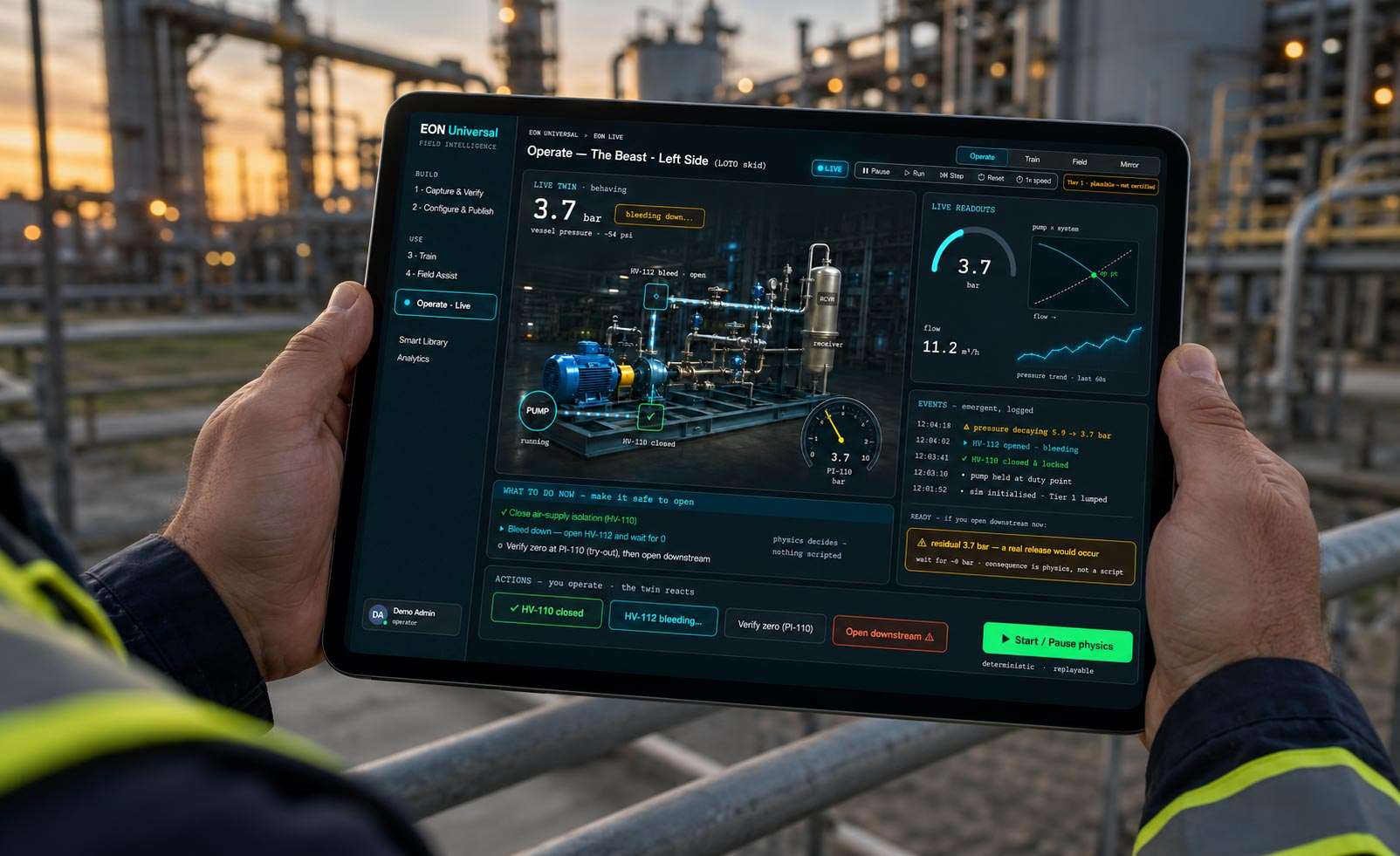
EON-Live-Dashboard-UI

The proof build this first

The same LOTO skid, now alive

One skid you already model in the Living Library. Add a minimal fluid network – valve states gate flow, one pump curve, one relief set-point – then run your existing lock-out slide, live.

Today EON Universal

Branches on an authored "pressure still present?" flag

Correct – but the pressure isn’t actually there. It’s a label on a decision tree, set because Universal knows the fact.

With EON Live

Residual pressure is a real, decaying state variable

It’s genuinely present and bleeding down. Open the valve early and you get a real, simulated release. No branch authored – the consequence emerged.

See it behave

Genesis replays it. Universal understands it. EON Live runs it.

Book a walkthrough and we’ll take one of your skids from a slide to a living, behaving twin.