
A technical look at the orchestration layer that reconstructs, identifies, scales, and pipes an entire facility from ordinary phone photos — and the intelligent objects that let operators run the plant once the twin is built.
IRVINE, CA — July 8, 2026 — EON AI Ventures today detailed the orchestration architecture behind EON Universal, the facility-intelligence platform that reconstructs a fully assembled, intelligently-piped 3D digital twin from a stack of field photographs — and then makes that twin operable by binding its components to live plant telemetry. The result is not a static model of what a facility looks like, but a running model of how it behaves.
Where a P&ID (piping & instrumentation diagram) captures connectivity and identity but no geometry, and a photogrammetric point cloud captures geometry but no meaning, EON Universal fuses both — under an orchestration layer whose central discipline is that no fact enters the twin until independent sources agree on it. The architecture, orchestration methodology, and recognition-to-operation framework are detailed in the accompanying white paper, “From Field Photographs to a Live, Operable Digital Twin.”
THE ORCHESTRATION LAYER: One controller, many specialists, one source of truth
EON Universal runs as an orchestrated pipeline rather than a single model. A controller sequences the work, dispatches purpose-built agents for each sub-task, and reconciles their evidence before anything is committed. The pipeline resolves in two stages joined by a match-making step:
- Recognition — understands what the parts are and where they sit, producing three deliverables: the Skeleton (3D structure), the Crops (named parts), and the Scale (real-world size).
- Configuration — rebuilds the facility from the Smart 3D Library, dropping correctly-scaled intelligent components into the reconstructed frame and routing the pipework between them.
Around both stages, the orchestrator runs a verification discipline: an adversarial agent reviews every step, per-part checks run in parallel, and the full-resolution source image is always re-inspected before any AI verdict is trusted — or overridden. A part is only believed when the photographs and the drawing agree; conflicts are recorded, never silently overwritten.
INSIDE RECOGNITION: Skeleton, Crops, and Scale — each cross-checked
Skeleton. Because a P&ID carries no geometry, 3D is reconstructed from the images themselves via structure-from-motion (COLMAP / pycolmap): roughly 3,700 SIFT features per photo, exhaustive matching, and incremental mapping with global bundle adjustment and EXIF-refined intrinsics. Each part’s position and extent is read by back-projecting its 2-D detection box into the point cloud, and near-duplicate camera angles (under 5° baseline) are excluded to keep the solve honest.
Crops. Each uncertain part is re-cut from full resolution and examined from about fourteen angles — the equivalent of walking around it — and cross-checked against its P&ID tag. A part is marked verified only when the imagery clears a confidence bar on at least two angles and the tag agrees. In practice this multi-angle discipline corrects mislabels, recovers parts missed at low resolution, rejects “parts” that are actually people, and flags tag-versus-photo conflicts for a human.
Scale. Structure-from-motion is scale-free — right shape, no ruler — so metric scale is recovered by multi-anchor consensus. Anchors include the Library’s known component dimensions, standard pipe and flange outer diameters implied by the P&ID line size, branded catalog nameplates identified from the imagery, and an optional single tape measurement. Each anchor implies a scale; the system takes the median, reports the spread as an error bar, flags outliers instead of averaging them away, and requires at least two independent anchors before it commits.
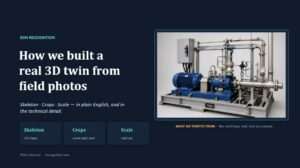
Click on the image below to access the How we built a real 3D twin from field photos presentation.
WHAT MAKES THE TWIN OPERABLE: Intelligent objects that know pressures — and take live telemetry
The components of EON Universal places are not inert geometry. Every object drawn from the Smart 3D Library carries its engineering attributes — design pressures, ratings, and connection semantics — and can be bound to second-by-second live telemetry from the running facility. Once the twin is assembled and piped, those bindings turn a geometric replica into an operable model: operators can watch real pressures and readings flow through the correct objects and, in effect, run the plant in the twin.
This is the distinction EON Universal is built to deliver. Reconstruction alone yields a picture of a facility. Intelligent, telemetry-aware objects yield a facility you can operate, interrogate, and reason about — the difference between a model of the plant and a working instrument of it.
FIELD VALIDATION: Reconstructed from a phone, proven against the real frame
On a live equipment skid reconstructed entirely from handheld phone photos, EON Universal placed 32 of 54 photographs into a single 3D frame at a mean reprojection error of 0.49 pixels, and the orchestrated verification pass raised confirmed parts from five to fourteen — correcting one mislabel, flagging four tag-versus-photo conflicts, and rejecting two “parts” that were people who had wandered into frame.
“Everyone can make a point cloud. The hard part is making the twin true — and then making it live. We fixed the data first: nothing enters the model until the photos and the drawing agree. Once the intelligent objects are in place and bound to telemetry, our customers aren’t looking at a picture of their plant. They’re running it,” said Dan Lejerskar, Founder & Chairman, EON AI Ventures.
Read more in the From Field Photographs to a Live, Operable Digital Twin white paper.
Learn more by tuning to our podcast.
About EON AI Ventures
EON AI Ventures is the company behind Work Intelligence — the captured, verified, and compounding knowledge of how expert work is actually done. Its Intelligence Flywheel platform (Genesis, Field IQ, Assess IQ) enables industrial enterprises to encode expert procedures into AI-guided simulations, deliver them to any worker on any device, and verify competency in the field. EON AI Ventures builds on a 25-year foundation of immersive learning technology deployed across more than 80 countries. For more information, visit www.eonaiventures.com