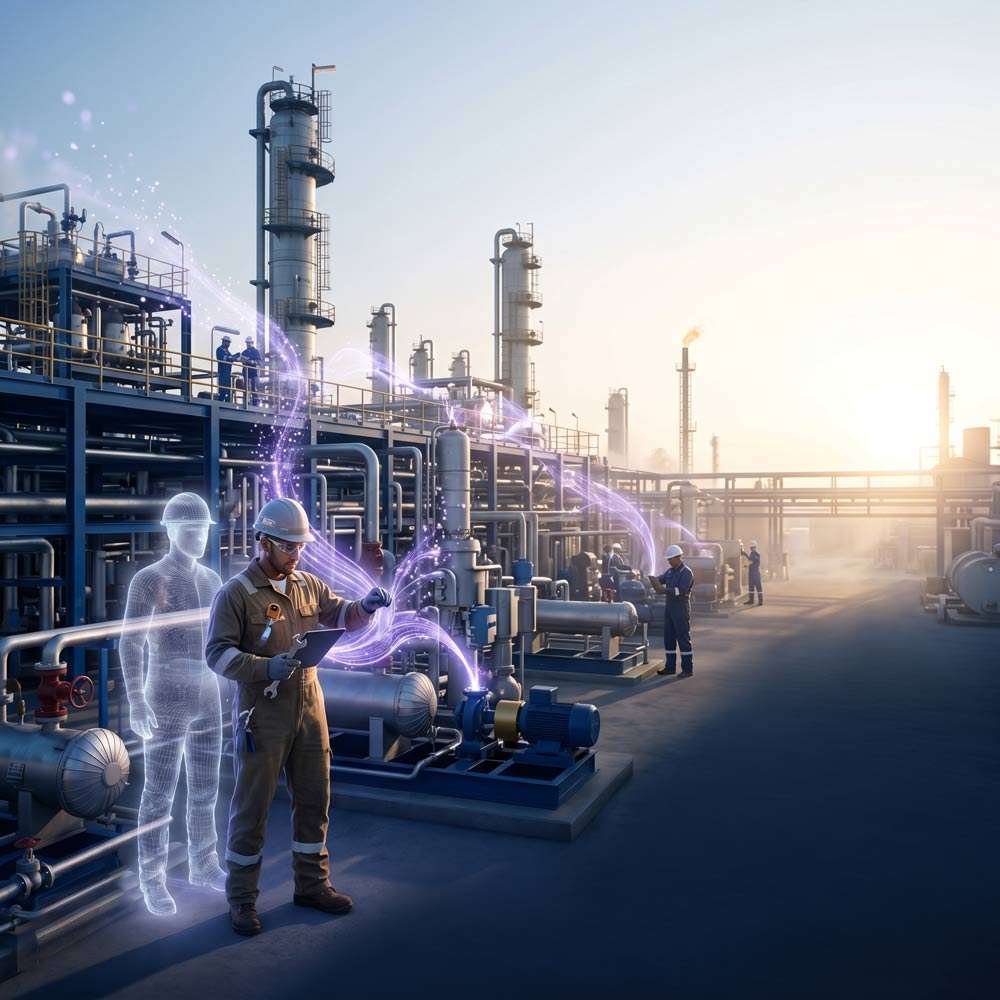
A worker three weeks into the job walks into a plant no one has mapped and is guided through it with the judgment of a thirty-year expert.
The people who can read an undocumented plant by instinct are retiring. The people replacing them are green in places where a wrong action is a safety risk, not an inconvenience.
<10% of equipment is reliably tagged or documented in the field so a green worker can’t trace what connects to what.
A facility is not a monolith to memorize. It is a graph assembled from a finite library of known components so you don’t model the locations, you model the vocabulary they’re built from.
Each one unique. Unbounded. Hopeless.
Bounded. Reusable. Compounding.
The system sees what the worker sees, composes the right procedure for the configuration in front of them even one it has never seen and knows when to hand off to a human.
Identify each component on sight; read its tag and gauges.
Infer how the parts connect role, not just name.
Assemble the right procedure for an unseen layout.
Watch the work; flag deviations in real time.
Low confidence or safety-critical → hand to a human.
Every verified outcome compounds the library.
The full vocabulary a technician physically touches structured against the industry’s own equipment taxonomy, so the system’s output maps straight into the data operators already keep.
Pumps, compressors, turbines, motors the prime movers.
Vessels, columns, exchangers, tanks contain and separate.
Start, stop, throttle, protect. Several safety-critical.
Pressure, temperature, flow, level the senses.
Connect, power, and protect the whole system.
For each class, captured knowledge is complete across six layers the ingestion checklist behind every guided step.
Taxonomy class, aliases, and tag-naming pattern.
3D model and multi-view imagery for recognition.
Subcomponents, maintainable items, and boundary.
What it does and its normal operating envelope.
How it responds to inputs and upset conditions.
Generic skeleton plus a facility-specific overlay.
Layers 01–02 power recognition · layers 03–06 compose the guidance
Capture expertise, deliver it at the point of work, measure the outcome, and feed it back so the system gets measurably smarter at every facility.
Structures expertise into the six-layer competence record.
Guidance at the point of work glasses or tablet.
Scores the worker and the guidance itself.
Feeds verified outcomes back into the library.
Routes each task to the right model and the right knowledge.
The trust gate decides when to guide, and when to escalate to a human.
The vision is decades old. It was impossible until each of these became usable at the same moment and the system is worthless unless all four work together.
Old vision failed on rusty, occluded equipment in the field.
Now: robust recognition, trained on synthetic data from 3D models.
Old systems were lookup tables no sense of the combination.
Now: reasoning composes guidance for a configuration never seen.
A manual is static; a veteran answers back and adapts.
Now: live, responsive guidance that knows when to stop.
Running it all, fast, offline, was uneconomic.
Now: the cost collapse makes it deployable across thousands of sites.
Enterprises run on systems of record but none captures how skilled work is actually performed. That is the layer EON Universal owns.
Resources
Customers
Product lifecycle
How work is performed
We ship a reliable, well-guided technician on day one and a system that gets measurably smarter with every job. That compounding is the part general-purpose AI cannot replicate, because it is built on real, proprietary expertise rather than averaged public knowledge.
Operating History
Operating
Institutional Customers
Customers
Platform Downloads
Platform